What's New?
Find out more about what’s new at Randwick & District Historical Society, including upcoming events and opportunities below, or call us today and we’ll be happy to help.
Our valued members can enjoy a wide range of benefits, including access to our interesting programme of events and gatherings for local history enthusiasts, which are held regularly.
SATURDAY HISTORY TALK
3 March 2026
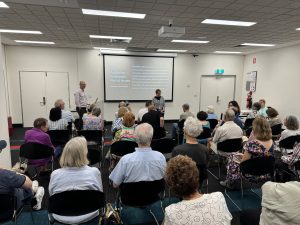
Notes on the presentation by Mark Sabolch on The Federation House Revealed: How it Really Came to Be
On 21 February 2026, the Randwick & District Historical Society welcomed architectural historian Mark Sabolch for a richly illustrated presentation examining the origins of the Federation house and its relationship to earlier Victorian styles.
Sabolch began by challenging the common assumption that ‘Federation’ is a clearly defined architectural style. Rather, he argued, it is better understood as an era − a transitional moment around the turn of the twentieth century. Australian domestic architecture of this period drew heavily on British influences, particularly the writings of John Ruskin and William Morris, whose advocacy of Gothic and medieval forms shaped the Arts and Crafts movement.
The ornate Victorian Italianate style − associated with prosperity in the gold rush era and exemplified by Osborne House, Queen Victoria’s Italianate seaside retreat on the Isle of Wight − was a dominant influence. Characterised by rendered brick, arches, columns, bay windows and wrought-iron lacework, it gradually gave way to Queen Anne and Arts and Crafts influences. These later forms favoured asymmetry, overhanging gables, exposed brickwork, fine timber joinery and a more picturesque, medieval character.
Sabolch described this shift not as a clean break but as a process of borrowing and adaptation. Australian architects combined elements from multiple traditions, modifying them for local conditions with deep verandahs and breezeways suited to the climate. Technological advances, such as the adoption of terracotta Marseilles-pattern roof tiles, also distinguished the emerging Federation houses from their slate-roofed predecessors.
He also explored the ‘battle of the styles’ in nineteenth-century Britain, referencing figures such as Richard Norman Shaw and debates between Gothic and Classical proponents. The term ‘Federation,’ first popularised by art historian Bernard Smith, helped Australians recognise this architecture as a distinct expression of national identity.
The lecture offered a nuanced account of how social and cultural change in the 1890s shaped a uniquely Australian domestic architecture.
Christine Yeats
President
Randwick & District Historical Society
Exploring Personal Links to Historic Local Buildings
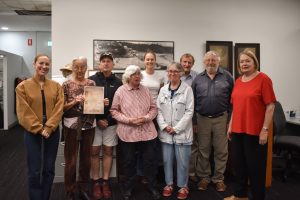
Members of the Society have recently participated in a research project being undertaken by a group of Master of Architecture students from the University of Technology Sydney (UTS).
The three students (Adelina, Mia, and Phillipa) are identifying older buildings in the Eastern Suburbs that have a special personal significance for people. They are documenting the history of the buildings and their value to people, as well as looking more deeply into why people have a special relationship with certain buildings and want to preserve them against the threat of demolition.
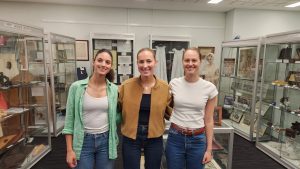
When they contacted the Society hoping to meet people in the area with personal stories about specific buildings, we emailed all our members. Of those who expressed an interest, eight were able to make it to a two-hour meeting with the students in our centre on 7 October 2025.
In the first part of the meeting, each person spoke about why some buildings were important to them. Over twenty buildings and areas were mentioned, notably:
- Blenheim House, the original home of Simeon Pearce built in 1848, which is currently being restored to become a local arts centre.
- 62-64 Carr St, Coogee, built in 1909, with 62 once the home of the Grand Pacific Hotel and 64 now the home of the Barzura café, two Coogee icons from the past and present, and the subject of a Newsletter article by Rona Wade in September, 2021.
- The Towers at 18 Alison Rd, Randwick, the subject of a recently published booklet written by two RDHS members, Maureen Norbury and Colleen Malone.
- The Wirths family home, near the top of Arden St, Coogee, built in 1916 as the home of the Wirth circus family, and now being restored to its earlier state.
- A house in Baden St, Coogee, built in 1925, which has very interesting links to James Joynton Smith (co-owner of the legendary Smiths Weekly newspaper) as well as architectural significance.
- The old Coogee Aquarium and Swimming Baths, originally built in 1887 and now the site of the Pavilion Restaurant.
- The Maroubra Fire Station, opened in 1924
- The Garden House Estate in Daceyville
Other buildings raised by interested members unable to come to the meeting included the Gower Galtees (a ‘striking example of art deco architecture’ built in 1940 at the top of Coogee Bay Rd), the old Randwick Tramways Workshops (King St, Randwick), and the Grotta Capri Restaurant (Anzac Pde, soon to be demolished).
The discussion highlighted the large array of great old buildings in the Randwick area. Some of the above have a long history central to the development of the area. Some have heritage listing, some do not. Some are leading examples of earlier styles of architecture (such as art deco). Some were the homes of famous people. And some are symbolic of valuable public services with a long presence in the area. Together, they present a marvellous picture of a history we should all be aiming to preserve.
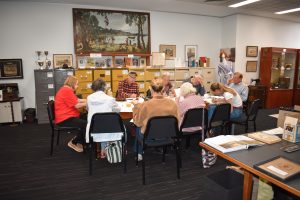
Members were then asked to complete a survey form developed by the students aimed at stimulating memories and drawing out more precisely what is important to them about the buildings. Is it a personal connection, the wider historical significance, the architecture, or something else? A lot of thinking and analysis had clearly gone into preparing the survey questions, and some members commented that it had made them think more deeply about why they are committed to maintaining our heritage.
There was an enthusiastic and collegiate atmosphere in the meeting, and everyone seemed to agree it was a great success. Adelina, Mia, and Phillipa said they had got the sort of information and insights they were after and will come back to us about their future action.
We were all impressed with their knowledge, understanding, commitment, and capacity to help us protect the heritage of our area. For the members present, it was a chance to pass on their knowledge of subjects for which they have an interest and passion, and potentially get the assistance of trained architects to document this. For everybody, it was also an excellent inter-generational activity.
Finally, this exercise once again showed what a valuable resource the Randwick and District Historical Society is for researchers and the community more broadly, not just in our collections of written material, photos, maps, objects, and artifacts, but also what is in the minds and experience of our members.
Bob Davidson, R&DHS Volunteer